
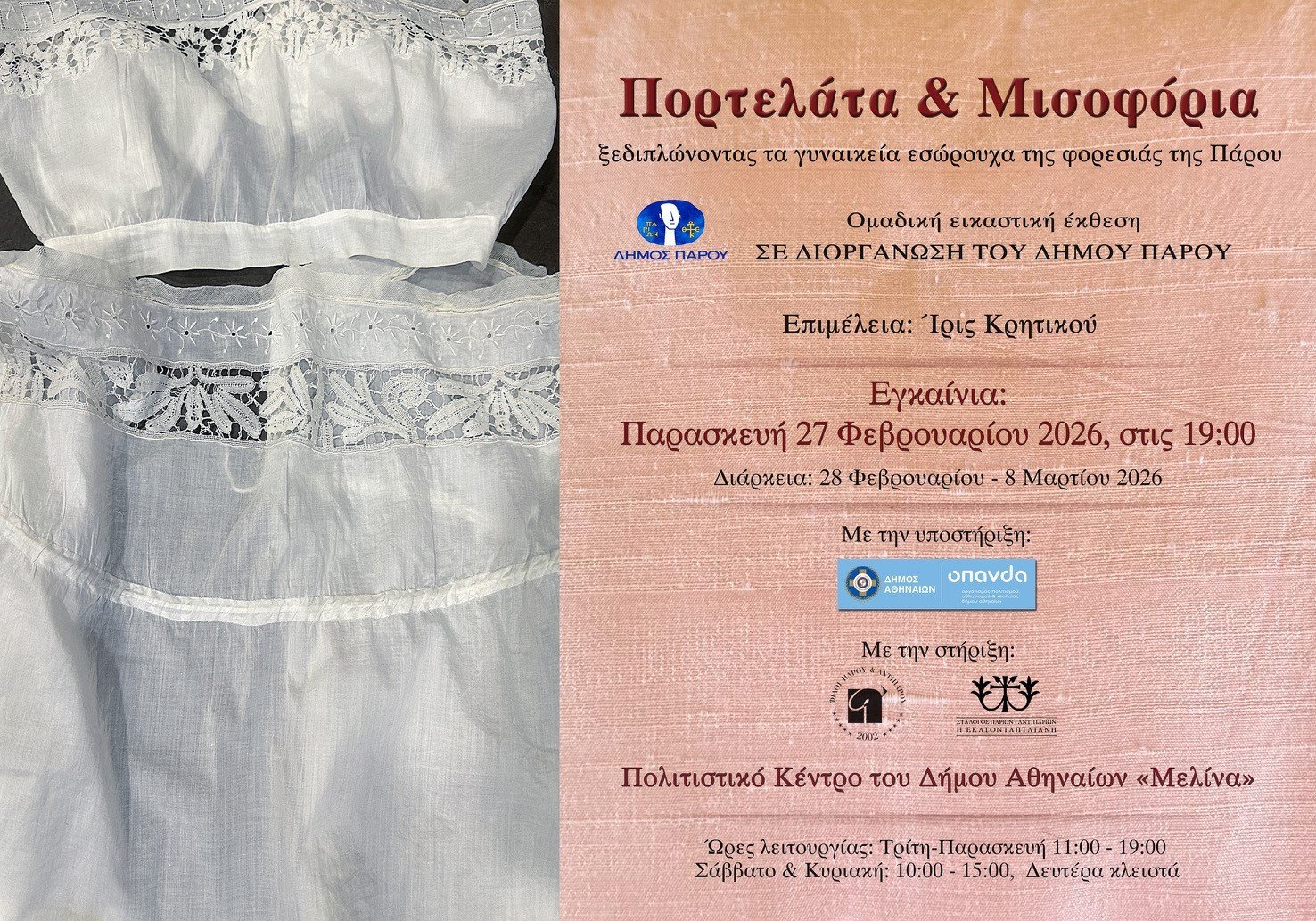
Unveiling the traditional Parian women's underwear!
Curated by Iris Kritikou
Opening: Friday, February 27, 2026, at 7:00 p.m.
Open Tuesday to Friday from 11:00 to 19:00
Saturday and Sunday from 10:00 to 15:00
Closed on Monday
About the exhibition
The traditional women's costume of the 16th century consisted of many undergarments and skirts. A headscarf, very long, was wrapped around the neck. One side fell forward to the left and the other to the back. An undershirt ended in small cuffs with a little embroidery. A mid-length dress with short sleeves ending at the shoulders with silk bows...
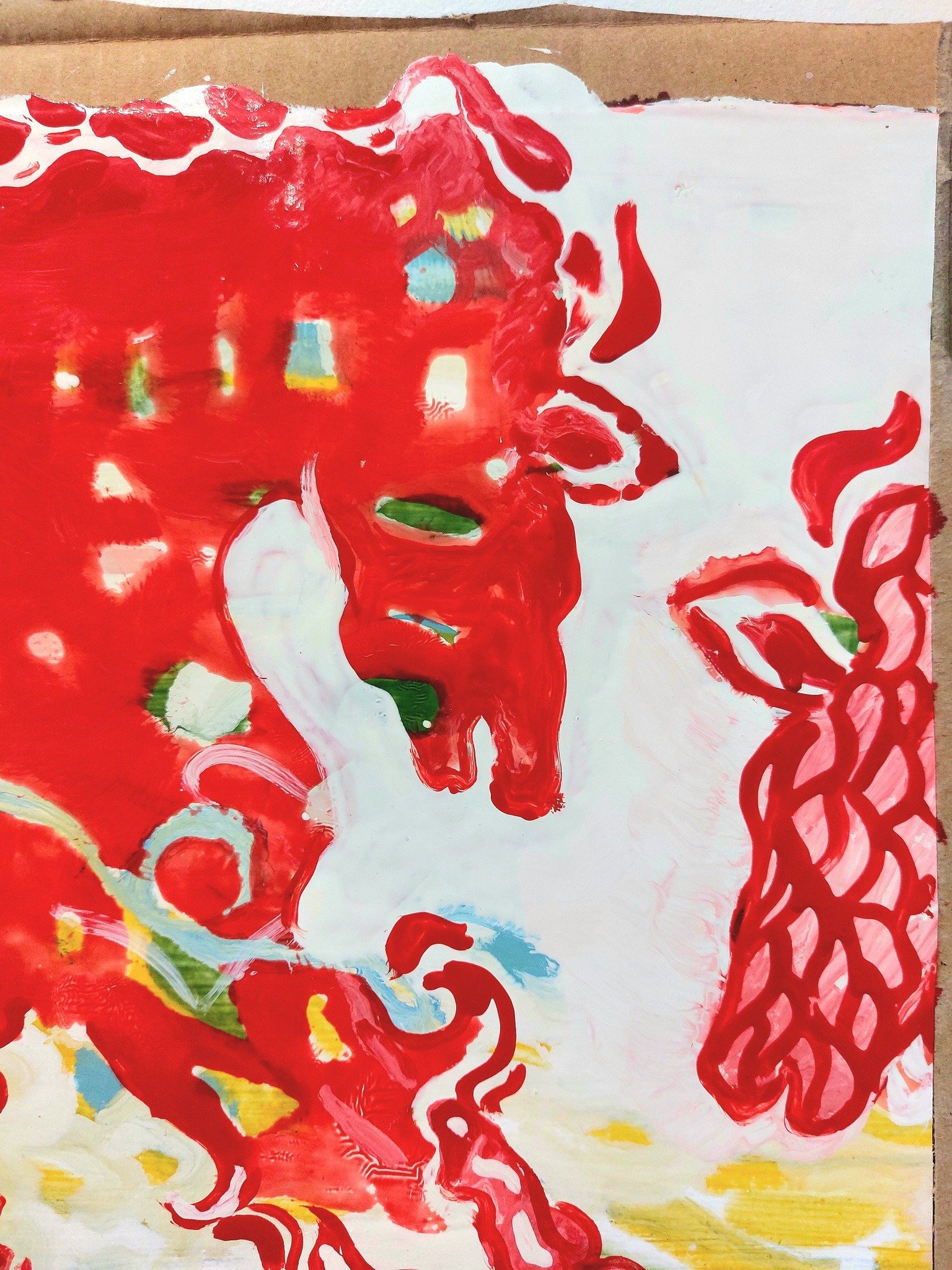
With the symbolic title "Portelata & Misoforia: unfolding the women's undergarments of the Parian costume," this year's exhibition, organized by the Municipality of Paros and curated by Iris Kritikou, will open on Wednesday, August 6, 2025, with the participation of fifty distinguished Greek visual artists, many of whom live and work in Paros.
In 1563, the chronicle of the French geographer N. Nicolay, a member of the entourage of the French ambassador to Constantinople, was published. Among the sixty paintings included in the publication was the famous "Young Woman of Paros," the first and since then often copied well-known image that immortalizes the old women's costume of the island. Important for the history of Paros is the work of the physician and botanist J. Pitton de Tournefort (1717), which preserves valuable information about the history, antiquities, quarries, monasteries, and temples, as well as the economy and people of the place, and on which many later works were based. Among them was the French nobleman Comte de Choiseul-Gouffier, who, in his three-volume work, included the famous engraving depicting Parian women dancing.
Taking the women's costume of Paros as her starting point, Ypapanti Roussou, whose research has been invaluable to this project and the visual dialogue it represents, notes, among other things, that the Parian costume of the early 20th century "was strongly influenced by the fashion of Western European countries, as the sea brought the islanders into contact with both the East and the West. The connection with Western Europe in particular dates back to the 13th century AD, as can be seen from the Italian influences in the island's medieval costume," while the inner pieces show significant similarities with those of the 16th-19th centuries.The poukamisa, "usually sleeveless - a basic element of both everyday and festive dress, worn loose-fitting like a modern dress," the bust, "a type of bodice worn over the poukamisa," the portelato, "the white breeches of the time, which had turn-ups and often reached to the knees, where they were joined to the stockings and tied with cords at the waist and on the turn-ups," the white festive or everyday dark-colored misofori, an "inner skirt, long to the calves and worn over the shirt," the white camisole, "the nightgown, with sleeves and reaching to the waist, with small pleats and lots of lace."
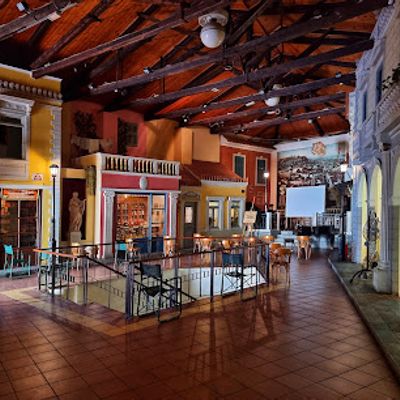
The idea for the exhibition was born from all of the above fragments. In an open dialogue with participating artists with roots on the island and in collaboration with the Municipality of Paros, a whispering and dazzlingly white microcosm was designed. The title of the exhibition, which is appropriately presented at the Paros Municipal Art Space in the historic Dimitrakopoulos building in Parikia, is proposed as an open field for dialogue, of symbols and matter, giving a distinct place to a narrative woven together by fragments of memory, matter, unseen episodes, and feelings that we do not want to lose.
The great variety of intricately embroidered undergarments of the traditional women's costume of Paros, but also the memory of the hands that sewed and embroidered them, their whispered, invisible beauty and their dozens of symbols, the white color with its myriad subtle shades, the passage of slow time and the inner world of women as it unfolds, the dances and celebrations, but also the silent endless days, the hidden stories, the unanswered love letters and the unfulfilled dreams, provided the inspiration for this exhibition: "The folk and aristocratic costumes, the costume of the unmarried and that of the married woman, the bustier and the pukamisa, the portelato, the misofori, the pukamisa, the skirt and the dress, the camisole, the apron, the boxer, the bodice and the berta, the toumblas and fanarata, as well as the other accessories and jewelry of the complex Parian women's costume, are just some of the items, just some of the names that, when heard, create vivid images and reveal little secrets. Starting from the multifaceted aspects and the painstaking embroidery work, which is a very old tradition on the island where women's costumes included many different undergarments, inspired by the form and material, the patterns and symbolism, as well as the extension, imprint, and interpretation of these objects in today's fragile female world, An open dialogue was designed with the hidden white garments of the women's costume of Paros, while an original small collection of old garments and accessories from private collections on the island is also on display. The importance of timelessness in the symbolism inherent in the use and decoration of undergarments was the starting point and inspiration for the participants, who worked with different media (painting, sculpture, weaving, embroidery, mosaic, construction, installation, photography, etc.), using contemporary and traditional techniques, handmade processes and a variety of materials, in dialogue with the original small core of old women's undergarments, created new works of historical, costume and sociological reference with prominent differences, historical references and eloquent references to contemporary and pressing social and racial issues," notes Iris Kritikou in the exhibition's curatorial text.
Participants in the exhibition include:
Kyra Aligizaki, Panagiota Apostolopoulou, Anny Archimandritou, Theodora Asprogenidou, Neva Bergemann, Marina Vlachaki, Anna Vlachou, Maro Voulgari, Maria Geroula, Stratigoula Giannikopoulou, Vasilis Gokas, Kristi Gregoriou, Maria Diakodimitriou, Maria Drakaki, Irini Zaimi, Annita Kalimeri, Katerina Kalitsounaki, Panos Kardasis, Marigo Kassi, Vasilis Kilitslis, Spyros Koikas, Maro Kornilaki, Nikos Leontopoulos, Mireille Lienard, Anastasis Madamopoulos, Minas Mavrikakis, Yakinthi Metzikofti, Manos Batzolis, Vasiliki Bisbikou, Labrini Boviatsou, Ismini Bonatsou, Roula Boua, Mary Dayanta, Giorgos Papageorgiou, Dionysia Papadopoulou, Vaia Papazikou, Marietta Papachaimona, Vivi Perysinaki, Michalis Sakalis, Katerina Sarafi, Ifigeneia Sdoukou, Eleni Siousta, Marina Stellatou, Nikos Triantafyllou, Claire Tsalouchi-Hatzimina, Irini Tsiraki, Amalia Ferentinou, Agapi Fesatidou-Psaraki, Eleni Fokianou, Maria Haniou.
Learn more >>
(in Greek)