
Marpissa
VERA ELIA KONSTANZA FRANKLI
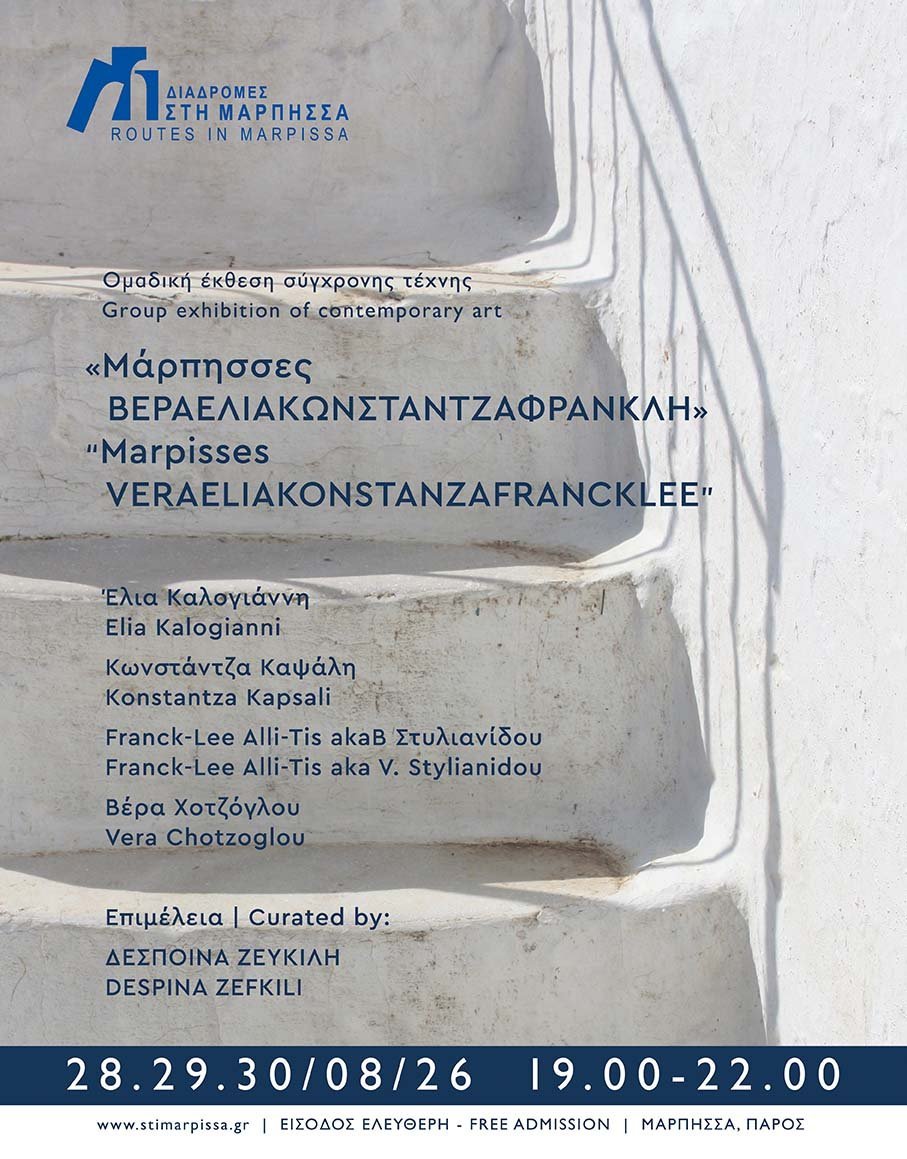
Art exhibition as part of the ‘Korés’ Routes Festival in Marpissa
Marpissa, Paros
28, 29, 30 August 2026
Featuring Elia Kalogianni, Konstantza Kapsali, Franck-Lee Alli-Tis (aka V. Stylianidou), and Vera Hatzoglou.
Curated by: Despoina Zeukili
‘Whilst you wait for me to prove something, I cling to my right to self-determination. I am whatever I want to be. In the past, I would have easily fallen into your trap; I would have tried, I would have bled. Now I carry explosives for social constructs. A bloke approaches me; I recognise an old acquaintance in his face. “You’ve changed,” he says. “Call me Short Story,” I reply.”
Georgia Tembridou, Short Story, published by Ungoverned States, 2023.
Women of different ages play a game of kum kan with a man at the Marpissa Senior Citizens’ Centre, staking their claim to carefree living, women of different ages write together and perform a play about a new collective of hybrid bodies – cyborgs – born on the island in the wake of the storm (of tourism?), a young farmer milks her goats, an elderly woman recalls her childhood, back when the women would take tables out of their homes every Sunday and set them up in the street, transforming it into a communal space for eating and socialising. What will the rain of milk bring, and what of the rain-soaked bodies? What do they discuss at the KAPI table, and what at the one set out in the square?
Is Marpissa female?
Looking back at the works created over the years as part of the visual arts exhibitions of the ‘Paths through Marpissa’ festival, one realises that the presence of the village’s women is predominant. Sometimes this is portrayed through lived experience, via the artists’ collaboration with women’s associations and groups, and at other times through a reflection on figures, customs and faces from the past or even from myth.
‘A sullen face with thick eyebrows and two swollen marks, undoubtedly breasts, and the pose with one hand at her side – they say this is the image of a tomboy. But what are you to make of her expression…’ we read in the description of one of the votive offerings recorded by the folklorist Zacharias Stellas in his book *Paros: Rough Sketches* (1975).
In dialogue with this year’s festival theme, entitled ‘Daughters’, the art exhibition ‘VERAELIAKONSTANZAFRANKLI*’ seeks out female stories that inspire us, relationships that help us break free from the boxes that oppress us (‘boy or girl?’), to look at both the trauma and the wonder, to mix up and redistribute words, and to hold fast to our right to self-determination. By conducting field research on the island, talking to its residents, and seeking out intergenerational, plural kinships which, even when they cause upheaval, act as a healing, reconciling and empowering force, the visual artists, the male visual artists, the female visual artists, the VERELIAKONSTANTZAFRANKLI* carry ‘explosives for social constructs’ and materials, soft or hard, for co-emotional constructs—those we build to dwell in safety, acceptance and freedom, so that we may exist.
*The exhibition title refers to Glykeria Basdeki’s poem ‘NANATZENIFRIDTAERSIMARIAVERONIKI’.
The works
Konstanza Kapsali, Koum Kan, 2026, single-channel video, HD, stereo.
One afternoon at the Marpissa Senior Citizens’ Centre, three women and a man of different ages are playing a game of Koum Kan. The film follows the game, the gestures and the everyday conversations that frame it, exploring the extent to which we can view older people through the prism of carefree spirit, humour and desire.
Vera Hatzoglou, A Table Under the Starry Sky, 2026, installation
The installation is based on the oral testimony of M., a resident of Marpissa, and her memories of her childhood, when every Sunday the women would take their tables out of their homes and set them up in the street, creating a communal space for lunch, conversation and communal living. The work focuses on this small, recurring gesture as an act of encounter, interaction and socialisation amongst women. The transfer of the table from the private to the public sphere is a transformative act, in which the street becomes a courtyard, the neighbourhood a community, and the personal becomes collective. The work creates a space for listening and reflection, with the central element of the installation being a sound composition based on the oral narrative of M.
Elia Kalogianni, Galaktofores, 2026, video installation
The work examines the practice of milking as a meeting point for different forms of femininity, reproductive labour and interspecies relationships. Filmed at the ‘Parion’ family cheese dairy in Marpissa, the video captures a young woman operating the mechanical milking system, collecting milk from female goats, which is then turned into cheese. Through the rhythmic repetition of the labour and the mediation of technology, the work explores the relationships between the human and animal bodies, highlighting milking as a process in which care, production and automation are interwoven. Milk, as a primary foodstuff but also as a vehicle for reproductive value, acts as a connective tissue between bodies, species and economies, revealing the ambivalent conditions that constitute the production process. Without adopting a dichotomous distinction between care and exploitation, the work approaches milking as a field of interdependence, where intimacy, labour,
technology and productivity jointly shape the relationships between human and non-human bodies. Through this encounter, questions arise concerning the multiple manifestations of femininity, reproductive labour and value within the context of contemporary agricultural production.
Franck-Lee Alli-Tis aka V. Stylianidou, Vrochina ‘ranokatébat*’[1], installation – performance.
Drawing on material from the archive of oral histories compiled by the Diadromes festival team in Marpissa and through field research in the village, the work takes its starting point from the contemporary reality of Paros, where the intensification of tourism development is violently transforming the landscape, labour relations and forms of communal life. Within the framework of a hypothetical narrative, following a violent storm on the island, a collective of hybrid bodies—cyborgs—emerges. These bodies are rain-like, condensations of water and heterogeneous materials, traces of memory, traditional tools and fragments from different time periods. Their skin bears traces of human and geological strata, technological remnants, oral narratives and future possibilities. Their presence opens a fissure in the linear perception of time; the past, present and future appear as flows that converge and interpenetrate one another, constantly transforming the possibilities of the present.
The work, comprising a poetic hypothetical narrative, a sound piece and a performance, proposes a different approach to time: not as a neutral framework within which events unfold, but as a relationship produced through the material, ecological and political connections between bodies, places and narratives.
The future does not appear as a horizon; it is reconstituted as a space through the intertwining and interconnections of what has already been and what continues to be.
[1] The word ‘ranokatéba’ is taken from Zacharias Stella’s book *Paros: Myths, Fairy Tales and Other Folklore and Linguistic Matters*. The use of an asterisk in the word ‘ranokatéba*’ in the title of the work refers to the expanded linguistic practice of the queer community, where the omission of the word’s gendered ending serves to transcend the gender binary and to encompass multiple gender expressions. In the case of the Greek language, the practice of omitting the final vowel is a familiar feature of many local dialects, serving as an element of oral expression and economy of speech. In this way, it brings together a traditional local linguistic practice with a contemporary queer politics of language.
[2] The concept of confluential originates from Antonio Bispo dos Santos, a Brazilian Quilombola theorist and activist, and is the central concept of his anti-colonial thought. Confluentia means that different forms of knowledge and cultures come together, flow together and engage in dialogue, without dynamics of domination leading to a homogeneous form of amalgamation.
Friday 28, Saturday 29 and Sunday 30 August 2026
Marpissa, Paros
Admission is free to all events
The organisers reserve the right to make changes to the programme.
Organised by: Routes in Marpissa
Co-organised by: South Aegean Region, Municipality of Paros
Under the auspices of the Ministry of Culture
Major Sponsors: Avant Mar, Blue Star Ferries, Cosmote
Media Sponsors: ERT, ERT3, ERT South Aegean, Second Programme 103.7, COSMOTE TV, STAR, Kathimerini, Disi 101.3, Empsisi 107